Price County History
From Virgin Forests to Modern Communities
Named for Wm. T. Price
1,253 Sq. Miles
The Timber Era & Incorporation
Price County was created in 1879 from portions of Chippewa and Lincoln counties, carved out during the height of the northern Wisconsin logging boom. It was named after William T. Price (1824–1886), a lumber baron and U.S. Congressman whose timber holdings directly benefited from opening the region to logging — an on-the-nose naming choice for a county that would be defined by timber for its first century.
The “Green Gold” era drew loggers, railroad tycoons, and settlers to the Northwoods. The vast white pine forests — trees 4 to 6 feet in diameter at the base — were more valuable than minerals. Logging camps housing 50 to 200 men dotted the Flambeau River watershed, operating primarily in winter when frozen ground made skidding logs easier. Spring thaw meant river drives, when thousands of logs were floated downstream to mills in Phillips and Park Falls.
The county population tells the story: 9,106 in 1900, surging to 11,132 by 1910 at the peak of the harvest. By 1920, growth had nearly stopped — the accessible old-growth pine was gone. For a first-hand account of life during this era, Wm. J. Bendixen’s 1930 review documents Prentice’s transformation from a rugged wilderness outpost into a thriving dairy and manufacturing hub, complete with firsthand details about the pioneers who built the community.
Industrial Grit & Resilience
As the white pine was harvested, tanneries and sawmills became the lifeblood of Price County’s communities. Prentice, named after Scottish-born timber cruiser Alexander Prentice who worked for the Wisconsin Central Railroad, grew into a major logging hub. The United States Leather Company tannery was one of the largest employers in northern Price County — processing hemlock bark into leather for the booming national market.
Then fire changed everything. In February 1906, flames broke out in the tannery’s dry loft, causing $75,000 in damage. The company rebuilt. Five months later, in July, a second fire swept through the facility, destroying the majority of the tannery and causing an estimated $400,000 in damage. The tannery was never rebuilt. The full story of the 1906 tannery fires — documented in the Prentice Calumet newspaper — illustrates a pattern that repeats throughout Price County’s history: a single industry dominates, a catastrophic event disrupts it, and the community adapts.
Prentice’s response to that disruption is still visible today. The Prentice Village History Walk guides visitors through 17 surviving landmarks — from the football field lights dedicated in 1962 to the VFW memorial and the old railroad junction — each marking a chapter in the village’s recovery from the boom-and-bust years. What was once a wilderness logging camp became a dairy powerhouse, shipping 4.5 million pounds of cheese in 1930, and eventually the crossroads community it is today.
The Cut-Over Crisis & Rebirth
By the 1920s, Price County’s forests were largely clear-cut. What had been endless white pine stands became a landscape of stumps, bare hills, and tax-delinquent land. Farmers tried to make a go of it on the sandy, nutrient-poor soils left behind — most failed. Fires swept through the dried slash left by loggers, threatening the few communities that remained.
The federal government stepped in. In 1933, President Herbert Hoover established the Chequamegon National Forest, purchasing thousands of acres of cut-over and tax-forfeited land across Price, Bayfield, Ashland, and Sawyer counties. Civilian Conservation Corps crews planted millions of red pine, jack pine, and spruce seedlings on the barren land throughout the 1930s and 1940s. Today, the Chequamegon-Nicolet National Forest encompasses over 1.5 million acres — much of it second-growth forest that barely resembles the original wilderness, but supports a thriving recreation and timber economy that Price County depends on.
The transition from exploitation to conservation is one of the most important chapters in Price County’s story. The same forests that were liquidated for profit in the 1880s now draw tourists, hunters, and outdoor enthusiasts who power the local economy. The land came back — different, but resilient, like the communities it surrounds.
Culture & Local Lore
Beyond the mills and rails, the social fabric of Price County was woven in its saloons, community halls, and art parks.
The Ripsaw Saloon
A deep dive into the legendary social hub of the logging era.
Wisconsin Concrete Park
Fred Smith’s world-famous sculptures that defined Northwoods folk art.
Have History to Share? 🏛️
Join nearly 3,000 members in our group to share vintage photos and family stories.

New at the Soo! Cranberry Ginger Mule!!!! Oh man! Leinenkugels Chippewa River Distillery, fresh squeezed lime, and some ginger beer! Wow! Now I gotta go try another just to be sure....


🍂 Who’s ready for a little Wisconsin farm fun? From Moo-tober Fest at Heim's Hillcrest Dairy LLC.. in Algoma to Happy Harvest Fest at Heidi's Happy Acres in Monroe, fall adventures are waiting across the state! 🎃🐐 Gather your favorite people and discover the welcoming faces...

Coffee History Devotional ☕ Coffee didn’t start as a “quick drink.” It spread through monasteries and study circles because it helped people stay awake for prayer, reading, and long conversations. Devotional thought: Staying awake is not just about energy. It’s about attent...

Can I really be “Skip Northwoods” if I’m not fully aware of the best spots to hike with my doggos? Honestly, I’m curious as to where you think the best spots are. We are new to the area and appreciate the input of people that know their alway around better than we do. Oh, I ...

Wisconsin’s 2026 youth deer hunt runs Oct. 10-11 for hunters 15 and under, residents and non-residents alike. Hunters 12-15 who hold a hunter education certificate hunt accompanied by an adult. Hunters 11 and under, or 12-15 without hunter education, must be mentored by an adult ...

Swing in, Great food is Par for the course.

Another great band at The Big Dipper

Wisconsin is in full-on fall mode! From gunny sack races and camel rides to Apple Cider Mules and colorful mums, our members are serving up unique experiences all over the state!Make your agventures count with WATA’s FREE Fall Farms BINGO digital passport! Now through November 1,...


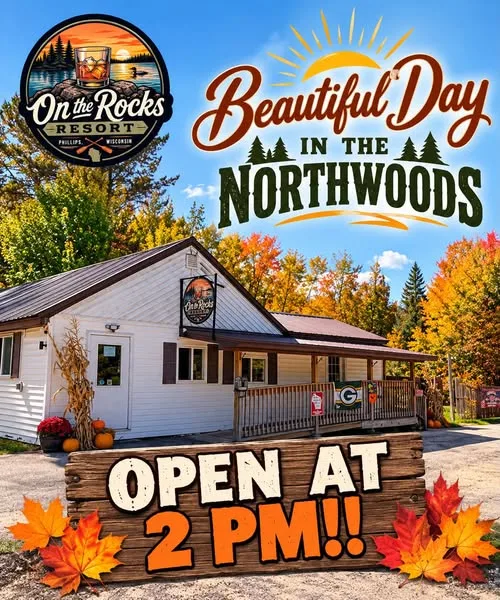
Beautiful day in the Northwoods! We’re 𝗢𝗣𝗘𝗡 𝗔𝗧 𝟮 𝗣𝗠! Come enjoy your Monday with us!𝗢𝗻 𝗧𝗵𝗲 𝗥𝗼𝗰𝗸𝘀 𝗥𝗲𝘀𝗼𝗿𝘁 – 𝗣𝗵𝗶𝗹𝗹𝗶𝗽𝘀, 𝗪𝗜#OnTheRocksResort#NorthwoodsWisconsin#PhillipsWI#Cheers#SupportLocal

They tried to break us with silence. They tried to drain us with administrative paywalls and hidden records. But we survived. And we didn't just survive—we built a movement. This is an exclusive sneak peek at Operation Transparency: The U.T.A.V. Awareness Project. We are turning ...

Sunday Funday at Flyway Resort Bar & Grill. Bloody Marys. Point Octoberfest on Tap. Featuring Chicken Bacon Ranch Quesadilla. Grab a bowl or cup of chili.

$7off any 16 inch pizzas.

Price County Timeline: Key Dates
| Year | Event |
|---|---|
| 1879 | Price County established from portions of Chippewa and Lincoln counties; named for William T. Price, a U.S. Congressman from Wisconsin |
| 1881 | Prentice platted along the Wisconsin Central Railroad line; village grows as a railroad division point |
| 1882 | Phillips founded and designated as county seat; named for railroad executive and lumber baron Elijah L. Phillips |
| 1892 | Prentice incorporated as a village |
| 1906 | Major tannery fires devastate Prentice’s industrial base; the United States Leather Company tannery and other businesses destroyed |
| 1910s–1920s | Peak logging era; white pine harvesting drives county population and employment; Flambeau River used for log drives |
| 1920s–1930s | As timber declines, paper mills and tanneries sustain the economy; Park Falls develops as a paper mill town |
| 1936 | Flambeau River Papers begins operations in Park Falls, eventually becoming one of the area’s largest employers |
| 1950s–1960s | Tourism emerges as economic driver; fishing resorts, cabin rentals, and outdoor recreation businesses grow |
| 1973 | Phillips Medisize (then Phillips Plastics) founded in Phillips, eventually becoming a global medical device manufacturer |
| 2020s | County navigates economic diversification, broadband expansion, and the PCUL/Lionite Mill redevelopment controversy |
The Name: William T. Price
Price County bears the name of William T. Price (1824–1886), a Wisconsin lumber baron and politician who served in the Wisconsin State Senate and the U.S. House of Representatives. Price was a powerful figure in the state’s logging industry, controlling vast timber holdings across northern Wisconsin. When the county was carved from Chippewa and Lincoln counties in 1879, the Wisconsin Legislature chose to honor Price — a man whose business interests directly benefited from opening the region to logging.
It’s an on-the-nose naming choice for a county that would be defined by timber for its first century. The “Green Gold” era — when white pine was more valuable than minerals — made men like Price wealthy while reshaping the landscape. The county’s forests were largely clear-cut by the 1920s, and the economic consequences of that extraction echo through every debate about development, conservation, and economic diversification in Price County today.
Deep Dive: The 1906 Tannery Fire
The United States Leather Company tannery in Prentice was one of the largest employers in northern Price County when fire destroyed it in 1906. The blaze leveled not just the tannery but surrounding businesses and homes. Prentice’s economy — built around processing hemlock bark into leather — never fully recovered its industrial base. The fire accelerated the town’s transition from a manufacturing hub to a residential and service community dependent on the railroad and, later, the highway.
The tannery fire is worth understanding because it illustrates a pattern that repeats throughout Price County’s history: a single industry dominates, a catastrophic event (fire, market crash, mill closure) disrupts it, and the community adapts. From hemlock bark to white pine to paper to tourism — each transition left scars and shaped the county’s character.
Explore Further
- Phillips — The county seat and commercial center
- Park Falls — Paper mill town turned outdoor recreation hub
- Prentice — The railroad junction that became a crossroads community
- PCUL & Lionite Mill — The modern development controversy