Fifield, Wisconsin
A Logging Town on the Flambeau River That Refused to Disappear
Fifield, WI — Quick Facts
| Zip Code: | 54521 |
| Population: | 568 (2020 Census, Town of Fifield) |
| County: | Price County |
| Area: | 71.6 sq mi (town) |
| Established: | Founded 1876 |
| Coordinates: | 45.9044°N, 90.1521°W |
1876
Samuel Fifield
Flambeau (South Fork)
Logging & Railroad
A Logging Town That Refused to Disappear
Fifield sits where the Wisconsin Central Railroad crossed the South Fork of the Flambeau River in 1876, deep in the big northern forest. The railroad brought loggers. The loggers brought timber camps. The timber camps brought a town. And then the town burned down.
In 1893, fire swept through Fifield’s business district and destroyed 60 buildings. The original town hall, built in 1882, was among them. The following spring, carpenter Theodore Ristin rebuilt the hall with the same dimensions: two stories, a clerk’s room with a vault, a two-celled jail downstairs, and an “opera house” upstairs where the community held dances, traveling medicine shows, graduations, lectures, and VFW meetings. Elections were held in the hall, and public announcements like the closing of the polls were made from the front balcony.
That building still stands. The Fifield Town Hall was added to the National Register of Historic Places on February 17, 1978 (NRHP reference number 78000339). Today it houses the Price County Historical Society Museum, operated by the historical society and open to visitors who want to see what a northern Wisconsin logging town looked like when it was built from scratch out of virgin timber.
Named for a Lieutenant Governor
Fifield is named after Sam Fifield, a politician and businessman who served as Wisconsin’s 14th Lieutenant Governor. Naming towns after political figures was standard practice in 1870s Wisconsin, and Sam Fifield presumably had enough influence with the Wisconsin Central Railroad to earn the honor. The unincorporated community of Fifield sits at the junction of Highways 13 and 70, about 4 miles south-southeast of Park Falls. The Town of Fifield itself covers 156.4 square miles with a population of 948 at the 2020 Census, one of the larger towns in Price County by area, and one of the most sparsely populated at 6.3 people per square mile.
2026 marks Fifield’s sesquicentennial, 150 years since its founding. Fifield, along with Ogema, is celebrating 150 years in 2026, making this summer a significant one for the community.
The Logging Era
Fifield’s early economy ran on white pine and the Flambeau River. Log drives on the South Fork moved timber from the cutting camps downstream to the mills. The Round Lake Logging Dam, also listed on the National Register of Historic Places, was part of this system. It controlled water flow to facilitate log drives during spring runoff. The dam is one of the last surviving structures of its kind in Wisconsin and sits within the Chequamegon-Nicolet National Forest.
The Fifield Fire Lookout Tower is another landmark from this era. Fire was the constant threat in a town built from dry lumber surrounded by dry forest. The 1893 fire that destroyed 60 buildings was not the only one. The Sanborn Fire Insurance Company produced maps of Fifield in 1894, 1901, and 1909, tracking what burned and what was rebuilt. Those maps are available through the Wisconsin Historical Society and document the town’s reconstruction cycle in detail.
The Tannery Fires Belong to Prentice
If you have heard about the New York Leather Company tannery fires in Price County, those happened in Prentice, not Fifield. The tannery burned twice in 1906, first in February with $75,000 in damage, then again in July with an estimated $400,000 in damage. The second fire destroyed the facility for good. We documented the full history of the New York Leather Company tannery fires, sourced from the Prentice Calumet newspaper. Fifield had its own fire troubles, but the tannery was a Prentice operation.
What to See and Do
Price County Historical Society Museum. Housed in the 1894 Fifield Town Hall at the junction of Highways 13 and 70. The museum holds artifacts, photographs, and documents from Fifield’s logging era and early settlement. The building itself is worth the visit. It is one of the few surviving 19th-century town halls in northern Wisconsin still standing on its original site. Operated by the Price County Historical Society, which maintains a website with current hours and exhibit information.
Fifield Fire Lookout Tower. Listed on the National Register of Historic Places. Used for fire detection during the logging era, when a fire in the surrounding forest could wipe out a town in hours.
Round Lake Logging Dam. Also on the National Register. A rare surviving example of the dam system that controlled water flow for log drives on the Flambeau River watershed.
Chequamegon-Nicolet National Forest. The Town of Fifield borders the Chequamegon portion of the national forest. Road access to forest trails, hunting land, and remote lakes is straightforward from Fifield. Head south or east out of town and you are in the forest within minutes.
Flambeau River. The South Fork runs through the town and provides paddling and fishing access. The river corridor is one of the defining features of Fifield’s geography and the reason the town exists where it does. The railroad crossed the river here, and the river moved the logs.
Notable People from Fifield
Robert W. Aschenbrener (1920-2009) was a World War II flying ace credited with 10 aerial victories. He flew P-47 Thunderbolts and later P-51 Mustangs in the European Theater. Barbara Anne Davis (1930-2008) played in the All-American Girls Professional Baseball League, the league memorialized in the film A League of Their Own. Both were Fifield natives.
Where to Eat and Drink
Fifield has a restaurant with a large deer statue out front on Highway 13. You will not miss it. For more dining options, Park Falls is 4 miles north and has the full range of services. The bars and restaurants page on pricecounty.fun has current listings for the area.
Getting There
Fifield sits at the junction of Wisconsin Highway 13 (running north-south) and Wisconsin Highway 70 (running east-west). From Park Falls, drive south on Highway 13 for about 4 miles. From Phillips, head north on Highway 13 for about 18 miles. From Prentice, take Highway 13 north through Phillips and continue about 12 miles past the city. The community is unincorporated. ZIP code 54524, elevation 1,489 feet.
What’s Nearby
- Park Falls, 4 miles north, the closest city with full services, grocery, and medical care
- Phillips, 18 miles south on Highway 13, the county seat
- Chequamegon-Nicolet National Forest, direct access south and east of town for hiking, hunting, and backcountry camping
- Free and cheap camping in Price County, including forest service campsites within driving distance
The Bottom Line
Fifield is one of the oldest settlements in Price County and it has the landmarks to prove it: a town hall on the National Register that survived the fire of 1893, a logging dam that survived the end of the log drives, a fire tower that survived the era it was built to watch over. This is not a town that has been restored for tourists. It is a town that simply did not go away when the timber ran out. If you want to understand what northern Wisconsin looked like when the lumber camps were running, the museum in the old town hall is the real thing. And at 150 years old in 2026, Fifield has earned the celebration.
Things to Do in Fifield, WI
Fifield sits on the Flambeau River and carries deep logging history. Here’s what to explore:
- Flambeau River State Forest: 90,000 acres of public forest with hiking, camping, fishing, and canoe access — Fifield is the gateway.
- Price County Historical Museum: Located in Fifield, covering logging history, the CCC camp, and early settler life.
- Lake of the Pines: A quiet lake south of town for fishing, kayaking, and swimming.
- ATV and snowmobile trails: Fifield connects to the Flambeau River Trail System and the Tuscobia State Trail.
- Round Lake Logging Dam: A historic reconstructed log dam on the South Fork Flambeau River — one of the last of its kind in Wisconsin.
Fifield is smaller than Park Falls or Phillips but has more public land per capita than anywhere in Price County. If you’re looking for things to do in Fifield, WI, the river and the forest are the main attractions.
Frequently Asked Questions
What is Fifield, Wisconsin known for?
Fifield is a historic logging town in Price County, located along the Flambeau River. It is known for its deep logging history, the Flambeau River Forest, and as a gateway to some of Wisconsin’s best musky fishing waters.
How far is Fifield from Park Falls?
Fifield is approximately 12 miles east of Park Falls, about a 15-minute drive along US Highway 70.
Can you fish the Flambeau River near Fifield?
Yes. The Flambeau River near Fifield offers excellent musky, walleye, and smallmouth bass fishing. Several boat landings and access points are available along the river corridor.
Is there camping near Fifield WI?
Yes. Several campgrounds are located in the Flambeau River State Forest near Fifield, including sites along the river with boat access. Dispersed camping is also available on national forest lands.


🌤️ Current Weather
🚧 Road Conditions & Construction
Roadwork Roadwork - Mainline One Lane Road Temporary Signal on WIS 13 NB from CUT OFF RD to MORSE RD. Weekly from 05/04/2026 to 11/06/2026, 06:00 AM Mon - 08:00 PM Fri Last Updated 4/20/26, 12:15 AM. County Ashland Type Roadwork Start / Expected End Time 9/28/26, 6:00 AM 10/2/26, 8:00 PM
Roadwork Roadwork - Mainline Moving Lane Closure on WIS 70 WB from SAWYER - PRICE CO LINE to LUDS LN. Daily from 09/14/2026 to 10/01/2026, 06:00 AM - 04:00 PM, M, T, W, Th (excluding Sun, F, Sat) Last Updated 9/10/26, 1:52 AM. County Sawyer Type Roadwork Start / Expected End Time 10/1/26, 6:00 AM 10/1/26, 4:00 PM
Roadwork Roadwork - Mainline Flagging Operation on WIS 102 SB from TAYLOR - PRICE CO LINE to SPIRIT LAKE RD. Daily from 09/21/2026 to 10/01/2026, 06:00 AM - 06:00 PM, M, T, W, Th (excluding Sun, F, Sat) Last Updated 9/14/26, 12:15 AM. County Taylor Type Roadwork Start / Expected End Time 10/1/26, 6:00 AM 10/1/26, 6:00 PM
Source: WisDOT 511 | Real-time data
Data updated: 2026-10-01 14:00:40
🌊 River Conditions
South Fork Flambeau River near Phillips
Source: USGS Water Data
Data updated: 2026-10-01 14:00:37
💰 Federal Spending
Per-Capita Federal Spending
Wisconsin Per-Capita Average
Total Federal Spending (FY2024)
Year-over-Year Change
| Fiscal Year | Total Spending | Per Capita |
|---|---|---|
| FY2026 | $93.4M | $6,646 |
| FY2025 | $138.7M | $9,871 |
| FY2024 | $135.9M | $9,669 |
Price County receives 50% less federal funding per capita than the Wisconsin average. Source: USAspending.gov (FIPS 55099)
Data updated: 2026-10-01 14:00:27
🎓 School Districts
🗳️ Recent Election Results
| Election | Contest | Candidate | Votes |
|---|
Source: Wisconsin Elections Commission
Data updated: 2026-10-01 14:00:34
💬 From the Community


New at the Soo! Cranberry Ginger Mule!!!! Oh man! Leinenkugels Chippewa River Distillery, fresh squeezed lime, and some ginger beer! Wow! Now I gotta go try another just to be sure....


🍂 Who’s ready for a little Wisconsin farm fun? From Moo-tober Fest at Heim's Hillcrest Dairy LLC.. in Algoma to Happy Harvest Fest at Heidi's Happy Acres in Monroe, fall adventures are waiting across the state! 🎃🐐 Gather your favorite people and discover the welcoming faces...

Coffee History Devotional ☕ Coffee didn’t start as a “quick drink.” It spread through monasteries and study circles because it helped people stay awake for prayer, reading, and long conversations. Devotional thought: Staying awake is not just about energy. It’s about attent...

Can I really be “Skip Northwoods” if I’m not fully aware of the best spots to hike with my doggos? Honestly, I’m curious as to where you think the best spots are. We are new to the area and appreciate the input of people that know their alway around better than we do. Oh, I ...

Wisconsin’s 2026 youth deer hunt runs Oct. 10-11 for hunters 15 and under, residents and non-residents alike. Hunters 12-15 who hold a hunter education certificate hunt accompanied by an adult. Hunters 11 and under, or 12-15 without hunter education, must be mentored by an adult ...

Swing in, Great food is Par for the course.

Another great band at The Big Dipper

Wisconsin is in full-on fall mode! From gunny sack races and camel rides to Apple Cider Mules and colorful mums, our members are serving up unique experiences all over the state!Make your agventures count with WATA’s FREE Fall Farms BINGO digital passport! Now through November 1,...


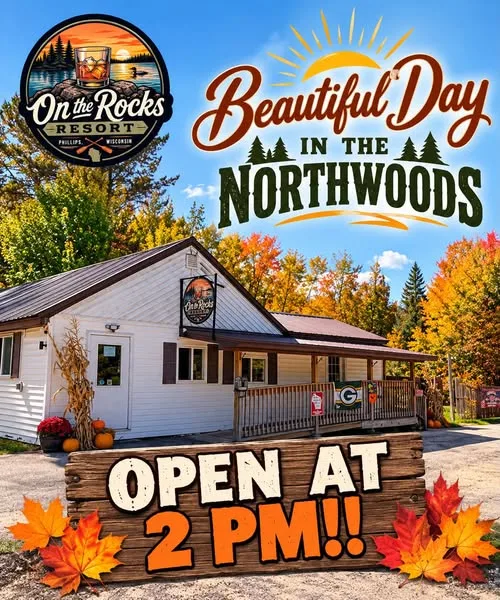
Beautiful day in the Northwoods! We’re 𝗢𝗣𝗘𝗡 𝗔𝗧 𝟮 𝗣𝗠! Come enjoy your Monday with us!𝗢𝗻 𝗧𝗵𝗲 𝗥𝗼𝗰𝗸𝘀 𝗥𝗲𝘀𝗼𝗿𝘁 – 𝗣𝗵𝗶𝗹𝗹𝗶𝗽𝘀, 𝗪𝗜#OnTheRocksResort#NorthwoodsWisconsin#PhillipsWI#Cheers#SupportLocal

They tried to break us with silence. They tried to drain us with administrative paywalls and hidden records. But we survived. And we didn't just survive—we built a movement. This is an exclusive sneak peek at Operation Transparency: The U.T.A.V. Awareness Project. We are turning ...

Sunday Funday at Flyway Resort Bar & Grill. Bloody Marys. Point Octoberfest on Tap. Featuring Chicken Bacon Ranch Quesadilla. Grab a bowl or cup of chili.

$7off any 16 inch pizzas.